Showing posts with label creative learning. Show all posts

Saturday, August 13, 2011

Personal Mini Sandbox

While window shopping this summer, I came upon a cute idea for a children's play/discovery area. It was a series of sand tables, each with a different theme. And it struck me -- I could make one (or my own version of one)!

While I was cleaning out the art room, I came upon some calcium sand that had been intended for DS12's hermit crabs and an empty container with a lid (even better than an open table). Perfect! I scrounged around the basement a bit more and settled on this stash:


And to inspire DS4, I set it up like this before I showed him:


The goofy guy loved it and played with it for a good hour one day, then asked to play with it again the next.


The possibilities for other themes are endless . . . pirates, zoo animals, deserted island (kinda what I have goin' on here), princess castle, diggers (we have a bigger bin with diggers and dried corn, which is also lots of fun!).

What theme ideas do you have that would be simple to create in a little box like this?

Are there other things that you've seen while shopping and you've thought, "I could make that!" ? Did you?


Monday, January 31, 2011

Monday Musings on the Creator in Me

Nurturing Creativity in a Family Setting

Long before my computer crashed (for the 4th time in less than a year), I had Amanda Blake Soule's blog, SouleMama, pegged in my favourites list. So when I stumbled across a book in our local library entitled, The Creative Family and saw that it was by Amanda Soule, I felt like I'd found a book written by someone I know. It's a delightful book of "simple projects and activities for you and your children" that now has a half a dozen or so bookmarks of ideas I'd  like to try with our family. And it got me thinking about the ways in which DH and I have been working to nurture creativity within our family. I narrowed it down to three broad categories that provide a framework for our endeavours: Resources, Models, and the Union of Work and Play. I'll elaborate with some specifics in hopes that perhaps you will recognize what you're already doing to foster your family's creativity -- or you will be inspired to explore some new options.

Resources:
While sometimes it can devolve into the curse of clutter (at which point we freecycle or sell!), we find it very difficult to pass up resources that might be even remotely useful in fostering a creative spirit in our children. Here are some of the things that came to mind as I contemplated our accumulation:
  • creative idea books (related to drawing, painting, creating costumes, building, quilting, cooking, paper crafting, seasonal activities, etc.)
  • art supplies (including beads, crayons, markers, coloured pencils, paint, various kinds of paper, fabric, pastels, clay, adhesives, decorative scissors, sparkles, stickers, materials from the recycling bin, etc.)
  • books about art and artists
  • reproductions of famous art (sometimes just in postcard size)
  • costumes/dress-up clothes (including animal outfits, shoes, dresses, scarves, hats, shirts, accessories)
  • journals (different ones for nature study, art, writing, ideas)
  • technology (including computers and cameras for making movies, photography, fort designs, dream house designs, blogging)
  • instruments (recorders, harmonicas, drums, cymbals, maracas, piano -- and a karaoke machine for those that like to belt it out, loud and clear :)
  • space (usually multi-purpose -- both indoor and outdoor)


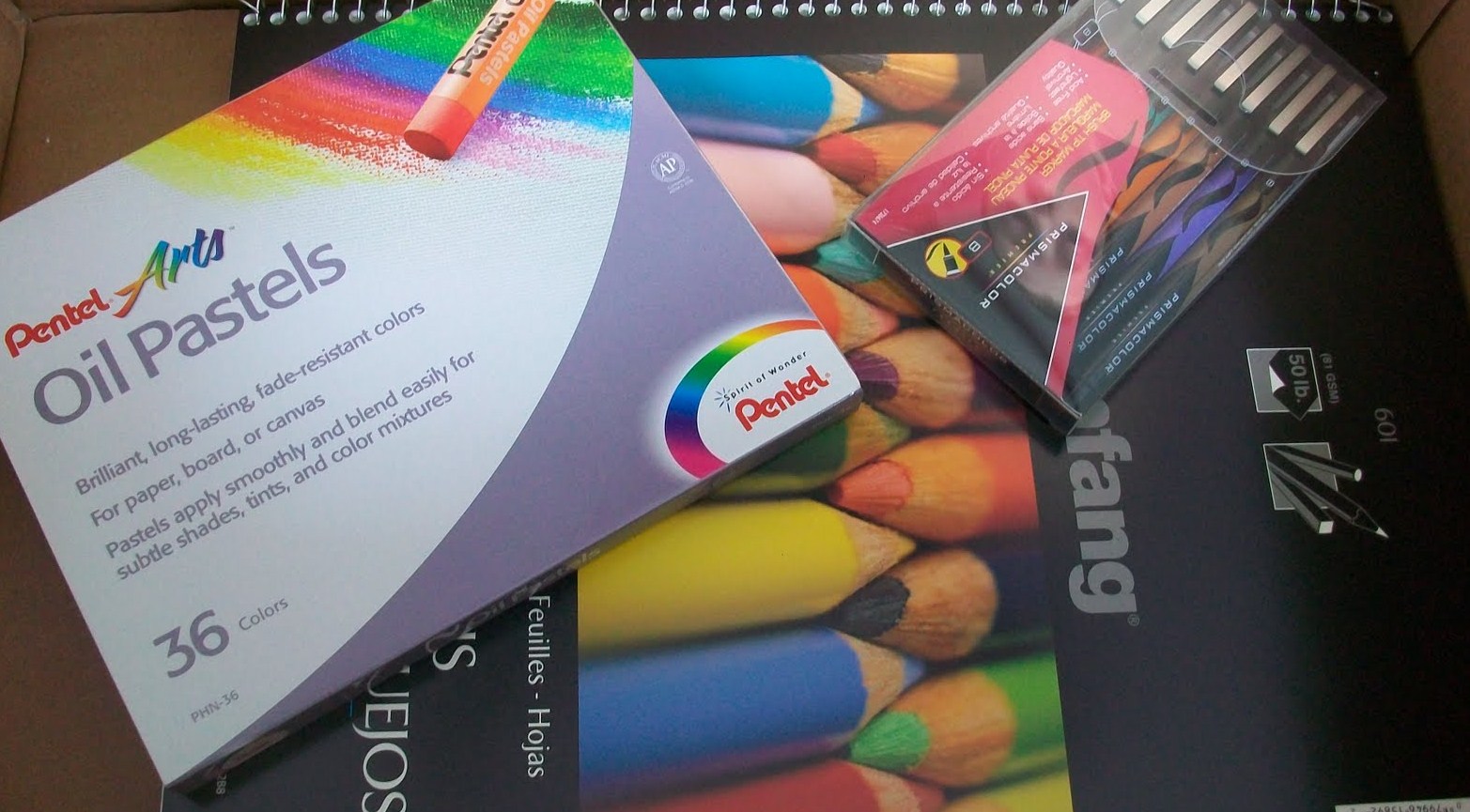
Some great art tools that I won in an online contest :)


Clowning around: dressing up -- just for fun.
 
 Models:
While I would like to say that we have an abundance of original art adorning our walls, inspiring our children and visitors, we don't. But of course we know that "creativity" goes well beyond art, and it is important for families to see it in action in a variety of ways. So here are some of the ways I've noted that we endeavour to show real life creativity as it exists in the lives of young and old:
  • Mom - The children observe me creating art, scrapbooking, decorating seasonally, cooking/baking, making gifts, writing/blogging, journaling (art, nature, prayer), and sewing.
  • Dad - DH can be seen woodworking, re-purposing (such as turning beds into benches, and windows into photo frames), cooking/baking, designing  and building furniture, constructing functional things around the house, decorating, scrapbooking, composing, directing dramas, singing, making gifts, and drawing.  
  • displays of family art work
  • visiting art galleries (and participating in hands-on activities)
  • touring community places where people use or display their creativity, including farms, gardens, apiaries, gift shops
  • Family Art Day, where Mom, Dad, and all the children participate in a collaborative piece of art


While purchasing food for our dog at a local alpaca farm, we witnessed the BIRTH of this little white lady named "Lola". In addition to that wonder of creation, we also got to see and feel several wonderful products that are created with alpaca fur.
   Union of Work and Play:
I'm not always very good at making learning fun, but I am working at providing opportunities for my children to enjoy being creative while working. Here are just a few ideas along those lines:
  • during read-alouds, they may be engaged in quiet creativity, including drawing, colouring, building, and imaginative play with small figures -- as long as they can demonstrate their attentiveness by participating in discussions about the readings.
  • incorporating a creative component to academic assignments (such as building a model of a scene from a novel, participating in an activity enjoyed by a character in a book, making a poster, writing a story that extends from the end of a book, re-enacting a component of something we've studied)
  • building character by being required to play (so if two sibs have been at each other, they might be required to play a jointly-selected game together in order to restore peace)
  • having the freedom to plan a menu for a family meal, then prepare it
  • setting the table for mealtime with their own personal flair


Exploring new vistas while listening to The Boy Knight
 This is just a glimpse of some of the ways we can encourage creativity within our families. Do you have any other ideas? Please share them in a comment -- I'd love to be inspired by them!


Friday, October 22, 2010

Monday Musings on the Creator in Me

I set this to post automatically, but for some reason it didn't -- and I didn't notice! Sorry if you missed me ;)

The theme at Homeschool Blogger (HSB) this week is "Teaching Science." While I've always loved learning about most things, I've never been what you'd describe as "strong" in science -- I guess cuz I'm more of a word girl. But over the years of homeschooling, I have come to love some of the "natural" and even "creative" ways we can learn about the world in which we live -- which is really what science is all about. According to sciencemadesimple.com, "The word science comes from the Latin 'scientia,' meaning knowledge. . . . According to Webster's New Collegiate Dictionary, the definition of science is 'knowledge attained through study or practice,' or 'knowledge covering general truths . . . concerned with the physical world.'" That's pretty easy to apply in everyday life! The physical world is God's creation, and any of our interactions with it furthers our knowledge and understanding of it.

One of our favourite ways to acquire knowledge of  our world is by caring for pets. While our menagerie is dwindling a bit, our grandest total of non-human inhabitants included a dog, a ferret, two hermit crabs, and eight rabbits, six of which were babies that we witnessed being born. We now have a dog, a cat, one hermit crab, and two rabbits, one of whom is our "special needs baby" because she was born with malformed legs and bad eyes. Let me introduce you to some of the critters we've loved and learned from here at Learners 4Life Academy . . .

Nikita is our latest addition to the family -- a 6 year old cat that we adopted from someone who couldn't any longer give her the attention she craves:


Our sweet ferret, Merlin, who died last Monday, on Thanksgiving weekend:


Caspian (Prince of Narnia), our 6 year-old golden doodle:


Some of our baby bunnies from the spring:


One of the babies, Honey-Bunny (aka Legolas) all grown up:


Now if we could only make these two friends:


The fact that all of these pictures were taken by children demonstrates that these animals are not just pets that share our home -- they're specimens for investigation. These critters are under constant scrutiny, and are therefore a source of information and knowledge -- outside of all that is to be learned by caring for them (which of course involves research about what food they thrive upon, how to care for their ailments as naturally as possible, and how to keep them as healthy and happy as possible). Have you thought about all the scientific things you can learn from your pets?

While it's wonderful to have these domestic animals to teach us, we also enjoy studying the fauna and flora of the natural world around us outside. We are blessed to live near a couple of conservation areas that enable us to study land and water animals at our leisure, so we often take our nature journals with us and document our observations. Sometimes, we even have the thrill of feeding birds right out of our hands! (Sorry, I didn't actually get a good picture of that.)


Besides benefiting physically from the fresh air and exercise we get from these outings (another scientific concept we can explore), we learn first-hand about plants and animals in their natural environment. Any questions we generate as we're observing and noting can then be answered by researching when we get back home. When I consider that during my elementary education, such excursions were considered rare and special "field trips," I feel blessed to be able to offer my children these learning opportunities on a regular basis. They can be "real scientists" virtually in our own backyard! Are there any special natural settings that you go to study the world around you? (The local zoo is another favourite of ours -- though it's not entirely "natural".)What kinds of things do you learn there?

Our kitchen provides lots of other opportunities for learning about science -- apart from all the experiments we conduct there for more formal science lessons. While we work together on all kinds of culinary creations, we learn about the impact of heat on raw foods, enjoying mini-explosions of things like cranberries cooking in a big pot:


And of course, we see liquids turning to solids when we cook eggs -- to go along with our reading of DS3's current favourite book -- Green Eggs and Ham ("I do like them, Sam I Am!" he announced -- once we convinced him to try them.):


When DS11 concocts his own version of chicken noodle soup, we learn about absorption as hard, dry noodles gradually soak up liquid and become soft and chewy:


There are chemical reactions to be observed as we put milk in our tomato soup -- with and without the dash of baking soda to keep the milk from curdling -- and the lack thereof when we forget to put the yeast in our batch of bread, or the baking powder in our coffee cake. What are some of your favourite lessons learned in the kitchen about the science of our everyday  lives?

Sometimes homeschoolers get hung up on curriculum, and worry that they're not doing enough bookish learning (and I'm guilty of that myself), especially about subjects like science. But the longer I travel on this journey, the more I realize that the organic learning we do in the course of living our lives is the more authentic learning -- the learning that will last a life time.

I've only scratched the surface of the scientific learning that can go on while we go about our daily lives. What are some of the other ways we can attain knowledge -- or "general truths" -- about the world around us? Be creative in your thinking, and please leave a comment about it :)


Sunday, October 3, 2010

Thanksgiving Prep Part 1

Next weekend is Canadian Thanksgiving, so we're in full preparation mode. We hit our favourite local farm last week and picked pumpkins and mums for pies and the porch. (OK, so the mums don't go in pies -- just on the porch.)

Isn't this a pretty site? (OK, I know some people think it's gross!)


We've been studying The Pumpkin Runner, a real pumpkin farmer who sustained himself for long distance running by eating pumpkin in all imaginable forms, so we tried some raw. DD8 and I quite liked it!


Since the plan was to make pumpkin pies from scratch, we set about doing so by scooping out the insides and baking them face-down for about an hour. 


Then we scooped the flesh out of the skins and made our puree . . . I hope you don't mind the mundane pix -- I just love the colours and textures!


We also roasted the seeds with some garlic oil left over from our last Blessing Meal, afterwhich DD8 made them into a face for our photo shoot:


Apparently I'm the only one that enjoys eating them!
Of course, she couldn't hold the camera without sneaking a self-portrait in there, too:


When it was time to make the crusts, I had to think creatively in order to find my favourite rolling pin. It wasn't where it belonged, nor was it in ANY of the drawers that someone might have THOUGHT it belonged if they were using any remnant of their logic skills. Before I got too frustrated, it did occur to me to look here, amidst the play-dough tools:

I shoulda known!

Anyway, once the crusts were made, it was time to start mixing the filling. DS3 wanted to help, so I decided to make it a bit of a directed learning experience. I told him I needed a teaspoon, and it was not the largest spoon, but the second largest spoon on the ring.


He got it right the first time! (I didn't know he understood ordinal numbers!)

Thinking it might just have been a lucky guess, I tried him with a 1/2 teaspoon, telling him that it was the third largest spoon. Again, he got it right away! The clever little duck! (Don't you love that he's dressed like a little pumpkin?!?!? I didn't plan that!)


 Speaking of ducks -- or rather chickens and turkeys -- we also did some decorating on the front porch this week, mostly with garage sale finds:


I love the fall mats DH picked up on sale in the spring:


In case you missed it in a previous post, this is the wreath DH made:

Anyway -- here are the pies all ready to go into the oven. I had more than enough filling, so I greased a casserole dish and just baked the filling in it along with the pies. We had it with ice cream tonight -- and it was delish! I just love the colour of the unbaked pies!

And fresh from the oven . . . they just need a couple of decorations, I think:


Finally, it was on to the pecan pies. (I was going to only make one, but DH reminded me that my pecan pies are always the favourite, so I should really make two!) DD8, photo-poser that she is, wanted in on the action and really did most of the work.

Mmmmmmmmm . . . are you drooling yet????


In addition to all this creativity in the kitchen, I got three blog posts composed today (two of which are scheduled for next week, this one being the third) -- so I'd say I had a pretty productive, creative day! I really am missing doing ART, though, so I'm hoping that I'll be able to find some time for that this upcoming week. I suspect that DD8 will be game to join me, and I wouldn't be surprised if others are, too. It has been a while!

Do you ever get caught up doing legitimately creative things, but wish you could be doing OTHER creative things? What would you be creating right now if you had the absolute freedom to do so?


Friday, September 17, 2010

Autumn Treasures DNG - Product Review


My children and I recently had the privilege of using our first Amanda Bennett "Download N Go" unit study,  "Autumn Treasures."  We received this unit free of charge in exchange for an honest review. No financial compensation was received.

DNGs are week-long, topical unit studies designed with K-4th grade students in mind.  They are, however, adaptable for use with older students (DS11 participated in several activities), as each unit offers a wealth of information via embedded internet links -- enough to satisfy the curious cravings of any inquisitive student. Daily book suggestions, lessons, activities, and lapbook ideas provide the parent with all that's necessary to conduct a thorough topical study. Books can be accessed through the local library, and do not need to be the exact titles suggested. The fact that these unit studies can be downloaded immediately means that studies can get under way right away with minimal preparation.


"Autumn Treasures" (available for $7.95 at The Schoolhouse Store) was a nice way to ease into our school year, though I think I would have preferred to do it a couple of weeks later, when the leaves are more colourful, apple and pumpkin picking are fully in-season, and it really is fall.

We began our unit by printing the pages we would most likely use, and going to the library to find as many of the suggested books as possible. Oddly enough (shoulda known!), the shelves were picked clean. (Those public school teachers -- I tell ya! ;-) (For the record -- I do love 'em -- I used to be one, and I'm married to a principal :-D ) We did manage to scrounge up a few books for most of the daily topics, which include:
Day 1: What is Autumn?
Day 2: Science Secrets of Autumn
Day 3: People and Places of Autumn
Day 4:  Time for Tips and Treasures of Autumn
Day 5: Goodies and Gadgets of Autumn

Here we are enjoying a little read-aloud of one of those books on Mom and Dad's bed:


Even the dog wanted to be in on the reading, though he did decide to catch a little shut-eye while he listened ;)


In our study of leaves and their changing colours, we did an experiment suggested by one of the unit links, which involved lots of fun snipping and smushing:


We drew the chlorophyl out of three different types of leaves. It's always fun when experiments work!


And everyone enjoyed the simple activity of leaf rubbing, though we didn't use the unit's page designated for that task:

"Autumn Treasures" also gave us opportunities to practise writing and other fine motor skills in an engaging way:


Most of the written work we housed in a lapbook, as the unit provided several templates for mini-books associated with the theme. An important feature of the DNG unit studies is that each one offers a wealth of information, including how-to videos, for those unfamiliar with the conept of lapbooking (a great way to document learning).


While some of the links offered material that was too advanced for my young learners, some of it I thought was worth keeping, so we printed it and put it in a pocket of our lapbook. We also incorporated some mini-books about butterflies from another study we did, but never got around to making a lapbook with them.

One of the things my children and I loved about this unit study was the amount of time we were encouraged to spend outside studying the real world. On one particular day we discussed the ways in which seeds travel, and after collecting an assortment of seed samples from around our neighbourhood, we set up a little science lab on the front porch. The children enjoyed examining their collection with a microscope and magnifying glasses -- and all those fluffy and clingy seeds remained comfortably outside the house, where neighbourhood children also enjoyed some impromptu studies ;-)


I think the sure sign that "Autumn Treasures" was a hit is the fact that after studying the season for the five days designated by the unit, DD8 asked why we had to stop!
(The great thing about homeschooling is -- we don't! :-)

"Autumn Treasures" has directed our attention to many of the wonderful things there are to learn about fall, and because we couldn't complete every suggested activity in the five-day time frame, we still have lots of material to use to satisfy our cravings for more knowledge and experiences. It has also reminded us of all the things we look forward to as the season sprawls before us -- decorating with corn stalks and hay bales and gourds, picking apples, making and eating apple and pumkin pies from scratch, cider with whipped cream, Thanksgiving celebrations . . .

What's your favourite part of fall? What creative endeavours does it inspire in you?

P.S. If you'd like to read other reviews of DNG's "Autumn Treasures," click here. And don't forget to check out all the other great titles available here.
One more thing . . .
"Autumn Treasures" is on sale (20% off) until September 24, 2010.
Related Posts Plugin for WordPress, Blogger...