Showing posts with label writing. Show all posts

Sunday, April 17, 2011

Sometimes I Don't Understand What I Read

Though more sporadically than I'd like, I'm still enjoying writing my responses to scripture in my prayer/poetry journal. Sometimes, though, I'm puzzled by my reading -- as with today's reading of Mark 11.

I wonder why
You cursed a fig tree
for not bearing fruit
out of season
when You were hungry.
You could have made the fruit appear --
received the gift of God
because You are He
who can move mountains
and cast them into the sea.
You proved positive your power --
but in the negative. Why?
Why a miracle of death?
How does the curse of the Christ
demonstrate that faith in God
will grant us the gifts of our hearts?

Open my eyes;
I cannot see.


Are there any passages of scripture you've been puzzling over lately?

Monday, March 21, 2011

Prayer Poetry

Sometimes I feel silly (or maybe it's pretentious) writing poetry -- and even moreso sharing it. But I read this weekend that more than one third of God's word is expressed in poetry. So, obviously God uses it to speak to His children, and He inspires them to write it. Therefore, I'm going to push the cat off my journal and keep at it . . .


Mark 1:13

For forty days
You were tempted
in the wilderness
with the wild beasts
by Satan --
You, the Son of God --
tempted by a fallen angel
who did not believe
he had enough,
nor that You
had enough.
He tempted you with "more."
How could he tempt You,
how could he offer
beyond what You have
when You have all --
when You are all?
And how can he
truly tempt me
when I have You --
the All Power and All Glory --
in me?
May I, too, submit
to the ministry of angels,
as you did,
and resist the temptation
to demand more than
the ALL that I already have.
____________________________________________

Do you find yourself wanting more -- more time, more energy, more space, more freedom, more something? (I know I do.)

Why do we doubt that in Him we have all that we need?

Monday, February 14, 2011

Monday Musings on the Creator in Me

Last week the theme at HSB Front Porch was Children’s Authors and Illustrators, and in our Monday Musings we explored ways in which we can appreciate these creative people. As I finished that article, it occurred to me that a good sequel would be an article that explored ways we can encourage ourselves and our children to be authors and illustrators. We really do have it in us – whether we ever “get published” or not! ;)


Ideas for adults:

  • Write letters. I mean REAL, hold-in-your-hand, pen-to-paper letters – to family, friends, children, spouses. Then, do a few doodles or clip out a few pictures from a magazine to adorn the letters and envelopes. These letters might just become a keepsake for the recipients, cherished for years to come. My husband and I corresponded for years before we were married, and each kept all of the letters we received from the other. On one of our wedding anniversaries, we sat and organized them all chronologically – so now we have a documentation of our friendship and romance. While they still hold value for us now, I believe they will have even more value to our children in years to come.

  • Keep journals. Here are a few ideas that nurture the author and illustrator in many of us:
    • Gardening journals with little diagrams of where to plant next year’s flowers and food, as well as little sketches of how favourite plants are growing
    • Pass-it-back journals to be shared with a spouse, a child, or the whole family. When she was about 10, my oldest daughter and I began writing notes to each other in a journal that we’d leave for each other to find, read, and respond. Sometimes we’d doodle little illustrations to correspond with the content and demonstrate our affection for each other. At another time in our family’s history, we would take a weekly opportunity to write kind words to each other in a Blessing Book, and these notes would be read aloud at our Blessing Meal. Words matter, and this is a little way to use them for the edification of others.
    • 
      An excerpt from my nature journal
      Nature journals are a way to draw our attention to the wonders of creation and document the beauty in the world around us. If we don’t feel like we can draw well enough (though it’s a great opportunity to practise!), we can always take photos, print the best ones, and make simple notes about the time, place, sounds, smells, and sights we experienced.
    • Personal journals are, of course, ways to document our thoughts, feelings, hopes, and ambitions – and a good way to sort through the ups and downs of life. Little doodles and illustrations here and there help to label our emotions and experiences.
    • Prayer journals are another form of personal journals, with a little more focus. Entries help us to see where we’ve been, and how God has been working in our lives. Several times in the last 13 years I’ve returned to a particular journal entry in which I’d drawn a diagram of what I viewed all our parenting options to be next to a page of graffiti-like doodles exclaiming, “Kill my will!” It was that very evening that the door of my heart flew open when we were presented with the blessing of our first adoption. What an awesome way to be reminded of God’s answers to prayer!
    • Poetry journals might not be everyone’s cup of tea – and yet I think we tend to underestimate our own abilities to write powerful poetry. If we try, we’ll find ourselves in good company. It was by the creative power of the Holy Spirit that David was able to pen the psalms. When the Spirit of the Creator is allowed to work in us, we might be amazed at the words that wend their way onto paper. Even if the poetry remains under lock and key in our journals, it is a powerful way of wrestling with words that give our thoughts and convictions shape and form.
  • Record the stories of our children’s births or adoptions. I know my daughters especially have often pleaded, “Tell me the story of when I was born.” What a gift to offer them a written version for them to keep tucked away, perhaps to share with their own children one day. Photos or simple drawings would add to the memory bank, reminding the children of how they were and are cherished.
  • Scrapbook. I know this might seem like a stretch – but when you think about it, the purpose of a scrapbook is to keep a visual documentation of a time period, and it usually involves words and pictures. A scrapbooker writes about and illustrates (with photos and decorative elements) significant life experiences. In my books, it counts towards being a writer and illustrator! 
  • Write down some of those great stories you tell your children or grandchildren. And if you're interested in publication, I just found this interesting site.
 Ideas for children:
  •   Have little people write and draw in shape books. Apples, pumpkins, emergency vehicles -- there are lots of patterns available for free online. This makes authoring and illustrating so much more fun!
  •    
     
    Canada lapbook
    
  • Create lapbooks. Not only is it a creative way to write and illustrate, it's a great way to document learning.
A Letter from a pen pal

  • Find penpals for your children, and encourage them to write letters and send drawings to their penpals. It's especially great for homeschoolers to connect with each other.
  • Sponsor a child and have your children write letters to him or her, and send drawings and little paper projects as well. 
  • Write a family newsletter or newspaper and include drawings and photos. Truly publish this by sending it to friends and family.
  • Journals -- of course, these are great for children as well. If your stuck for ideas to encourage journaling, have a look here.
  • Create homemade books from scratch. You can start with plain paper, paper bags, a stack of note cards, cereal boxes, fabric -- you name it! Here are some more ideas to get you started in writing and illustrating homemade books.

 These are just a few ideas that we can use to jump-start the writer/illustrator in each of us. And when we consider that the Word was God, and the Word was with God (John 1:1) -- it should come as no surprise that, in the image of God, we are created to work with words and images.

What ideas do you have to nurture the author and illustrator in each of us?


Wednesday, November 10, 2010

The Write Foundation - Product Review


As a trained English teacher and writer at heart, you'd think I'd find teaching my children how to write a breeze. Ya. Not so much. It's hard -- and I need all the help I can get.

But finding a good writing program that works in a home setting is difficult. It's hard to find a balance between formally teaching the rules of writing and inspiring a natural flow of ideas from mind to paper. I don't like rigidity in any curriculum, and yet loosey goosey doesn't work for me either.

So, I was hopeful when I learned that I would have the opportunity to review The Write Foundation's "Sentence to Paragraph Writing Lessons 1-15". The website promises easy-to-implement lessons that take students through the writing process to "improve writing skills" and "energize reluctant writers."

While I'm not the best planner, I do like organization, so one of the things that appeals to me about The Write Foundation is that lessons are systematically organized and broken down into sections. The teacher's book is conveniently spiral bound, and the student pages are loose-leaf, three-hole punched for easy insertion into binders, making organizing notes easy. (And an organized notebook is emphasized right from the start, which I like.) I recognize wise counsel in the manual's introduction, where teachers are instructed to use the curriculum "however it works best for them and their students [because] quality curriculum lets teachers teach with their own style, without being a slave to it" (2). I also like the fact that teachers are encouraged to recognize that learning to write well is a process that takes time and practice through repetition of basic principles, and therefore students should be given multiple opportunities to learn the different principles rather than being required to repeatedly revise a single piece of writing until mastery is demonstrated. I also very much like that students are required to type their finished pieces so that their work is polished and well-presented, especially since my son finds the physical act of writing very challenging.

Now that DS11 and I are several lessons into the program that could last us through the better part of our school year, I have mixed opinions about the program. Ironically, the obvious effort to make directions clear for teachers actually results in muddying instructions as there are too many variations of the same directives. For example, the first lesson in the teacher's manual is laid out in 5 sections and then is followed by a page entitled "Sentence to Paragraph Assignment 1," which seems to be a condensed version of the preceding six pages. I, however, initially took it to mean that it was an assignment in addition to what had already been done. As well, the acronyms for work sheets (WS) and teacher presentation pages (TP) are intended to clarify with simplicity; but a glance at a label like "Mind Bender P1 A3: WS 2 (TP2)" overwhelms this reader and creates confusion rather than clarity. (Though not included in the purchase price, the curriculum advocates the use of Mind Benders books to add a fun logic component to the program.)

I appreciate the fact that there are a variety of writing activities within each lesson, and that students are required to make use of writing resources, such as dictionaries, thesauruses, peers, and various texts (such as books and magazines) from home. Students are also challenged to exercise creativity in the context of using these tools. For example, while studying alliterative words, students are required to use a thesaurus to help construct silly sentences about subjects that appeal to them. However, the worksheets provided to accomplish these tasks are lacking in instructions for the students, which means individuals (like DS11) who need textual directions for constant reference are at a significant disadvantage.

I am also concerned that there is sometimes a discrepancy between what is taught and what is given as an example to illustrate the concept that is taught. For instance, in the "Concrete Poetry" section of Lesson 2, we are told, "Letters of a word are drawn into the shape of the meaning of the word, which is the subject of the poem, using the word itself to form a picture illustrating the individual word" (examples from the text are below).


Outside of the fact that this is a very narrow definition of the term "concrete poetry" (see a more accurate definition here), some of the subsequent suggestions do not conform to the definition given. Instead, students are instructed to simply illustrate words to suggest their meaning, such as: "Dog - write the word dog drawing a face of a dog in the d, o, or g or all 3; Flag - make the letter f into a flag or the letter l into a flag with the flag flying above the other letters; Lips - make the dot over the i into lips" (Lesson 2: Page 6). While it may not seem like such a serious discrepancy here, it weakens the credibility of the curriculum as a whole, in my opinion.

I do like the fact that language concepts are taught in a spiral fashion throughout the program. Concepts are not simply introduced once and then left as "learned." Instead, students are challenged to keep applying their knowledge in multiple activities so that they can master the concepts. Recognition of parts of speech, for example, is a thread that runs throughout the series of lessons, and students are required to work with them in a variety of ways (such as identifying them in sentences, finding variations for ordinary ones using reference books, and playing with them in silly or fun contexts). Sometimes these activities are a bit stifling in the sense that they involve filling in a lot of charts -- but as the introduction instructs, we can use these as we see fit. So, when I feel that the busy work of filling in blanks becomes too tedious for DS11, I can reduce the expectation and just ask for half to be done -- especially since much of the work was originally designed to be done collaboratively in a classroom or co-op setting.

Scaffolding is another important feature of the program. Students begin with the basics of words in combination to form structured sentences, and gradually work their way up to sentences in combination to form structured paragraphs. Within this context, they learn about comparison and contrast, outlining, organization, figurative language, parts of speech, and poetry. That pleases the English teacher in me, though not so much my reluctant writer, who has yet to be "energized" or really inspired by the program. (To be fair, it's difficult to evaluate a whole program in just a few weeks of use.)

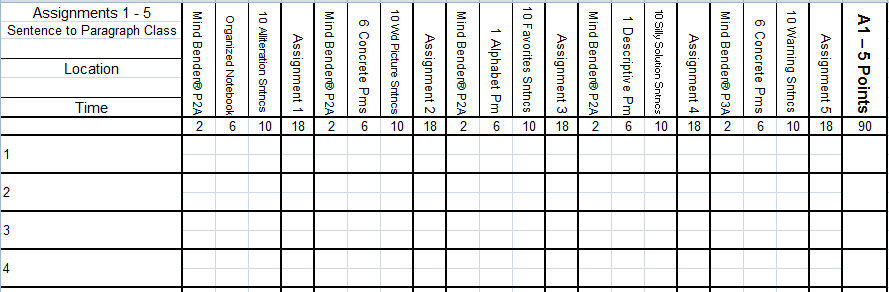
Another strength of The Write Foundation Sentence to Paragraph curriculum is the abundance of teacher tools offered in the additional resources (usually in CD format, though received by me via email attachment). Perhaps most helpful for teachers of multiple students are the tracking sheets for evaluation, such as this one for recording assignment grades:


Helpful checklists are also offered, such as this one for students to self-evaluate their writing before considering it "finished":


Although I have mixed opinions about The Write Foundation program so far, I am grateful for the opportunity to try it, and I do think that I will continue to use it with DS11 because it is flexible in its delivery (i.e. I can determine how long we spend on a lesson rather than the lesson determinng that for me), and I do believe he's learning significant things about writing (even if he's not particularly "enjoying" it).

If you are interested in learning more about what The Write Foundation has to offer, I would encourage you to visit their website, which offers detailed information about the different levels of their writing program, and the intended audience of each. It is also worth noting that the creator of the program, a homeschooling mother and teacher in public and private settings, is open to helping parents determine which component of TheWrite Foundation program is best suited to individual needs, so contact is encouraged. 

If you'd like to read what other TOS reviewers have to say about The Write Foundation, visit the Homeschool Crew Blog.

I received this product free of charge in exchange for an honest review. No other compensation was received for this review.

Wednesday, September 1, 2010

Vantage Learning's "My Access! Home Edition" Writing Program Review

According to the Vantage website, "MY Access!® Home Edition is an online writing application which fits neatly into any curriculum! Whether you're homeschooling, tutoring students after school, or just trying to help a child improve his or her academic confidence, you'll enjoy the time-saving technologies, valuable self-paced instruction, and motivating feedback in MY Access!®."

Having examined the product, I can attest that those statements are pretty accurate!


 We're still in "summer mode" as the time has come to write this review, but we have taken the opportunity to do a little bit of easing into academics with some My Access! writing assignments. And I have to say, I'm really excited about the fact that my family will have the opportunity to use this on-line program all year! I believe it will give our writing lessons the direction and support we need.

Here are some of the cool features I have observed in my examination of the program:
  • Account set-up is easy, and you are encouraged to use pseudonyms for identity safety and security. As you can tell by my use of a pseudonym and unidentifying labels for my children on my blog, I like that.
  • Parent and Student User Guides give a good overview of how the program works. Personally, I find it easier to just learn by using the program-- but those who need to read before doing will find these guides helpful.
  • The program offers a good list of writing assignments, categorized by age, but it is easy to customize assignments by entering your own writing tasks. For example, before we went on vacation, I entered an assignment asking my students to write about what they looked forward to most about our up-coming trip. Entering the assignment was just like using a word processing program -- very simple.
  • Students can create their own writing tasks by using "topic wheels" that generate creative beginnings, middles, and ends. Students can click on these wheels until the computer has generated a topic that inspires them as a writer.
  • Regular updates about student progress are sent to whatever email addresses are provided to the program. That means both parents -- and even grandparents, if you wish -- can be kept abreast of writing assignments and assessments. I like the fact that my husband can have automatic access to our children's work and progress reports without me having to remember to show him! ;)
  • If desired, student work can be "published" in the form of a newspaper that is sent to the inboxes of people you specify. This is an easy and fun way of creating a finished product that can be shared with interested people.
  • Writing tasks are divided according to different purposes, including narrative, persuasive, and informative.
  • External movitators and timelines can be established. Students earn points by participating in learning activities and achieving writing goals, so parents can establish external rewards to be earned when students accumulate a specified number of points within a pre-determined time frame. For example, DS11 and I decided that if he earned 250 points on My Access! by the end of August, he could get a small Lego set. For reluctant writers, sometimes it takes an external movitator to get the engine revved enough to get somewhere with a difficult task.
  • Writing assignments are accompanied by a "Writer's Course." This I love. Prior to doing any writing, students can learn or review the features of a well-constructed and composed essay. Detailed instructions AND illustrative examples are offered so that the student can get a good grasp of what is expected of them in their own piece of writing. At the end of the course, students are provided with the opportunity to plan their essay by creating an outline, which is then accessible to them at all times while they are writing. As a former high school English teacher, I appreciate the thorough yet concise instruction that is available to students as they undertake their writing assignments in the My Access! program.

  • As you can tell from the screenshot above, numerous resources are at the fingertips -- or cursor tip -- of the writer. Within the frame of the writing window, students may click on any of the following helps: My Tutor, My Editor, My Checklist, My Outline, Writer's Toolbox, and Writer's Course (described above). My Tutor provides revision strategies, challenging the writer to think about specific aspects of their work. My Editor offers specific suggestions for changing the grammar and construction of sentences. My Checklist is a checkable list of criteria for the writer to evaluate their work in the following categories: focus and meaning, content and development, organization, language use and style, grammar and conventions. My Outline reveals the writer's pre-planned essay for easy reference. Writer's Toolbox gives access to the rubric (evaluation criteria), writer's  models, writer's guide, word bank, genre outline, focus checklist, and a word count. Wow! How awesome is that?!?!? A student who is independent and self-directed will be good-to-go with this program; a student who needs lots of support and direction will have everything they need right in front of them and can easily be directed to the appropriate resources.
  • In addition to the writing courses and assignments, students may engage in writing activities designed to build their skills even further. Points are earned by doing these activities, which are geared toward selected proficiency levels, from "below proficient" to "advanced proficient." So there are lots of opportunities to develop skills while enabling the student to achieve those motivational point goals described above.
  • Once a student has submitted an assignment, My Access! evaluates it, then outlines a set of revision goals. Each goal is specific and offers examples to illustrate what should be done. In addition, the program offers activities designed to help the writer better understand the revisions that are necessary. The thoroughness of learning opportunities for students is truly impressive!
  • Vantage Learning hosts a blog and a community forum to provide additional support to parents and students. It's always comforting to know that we are not alone in this teaching endeavour, and that help is available when we need it!
To date, there are few faults that I find with My Access! Home Edition. Both DD12 and DS 11 described the lessons in the Writing Course as "weird" -- I think because they thought the editor character of the "Daily Access News Team" was a bit hokey -- but that's not such a big deal, since they're used to real, alive ME being their teacher!  :) But speaking of me as the teacher -- I confess that I was a little put-off when one of the quizzes suggested I, the English teacher, had given wrong or incomplete answers when I assisted my frustrated daughter!!!! Perhaps it was just a problem with our computer, but some of the quiz pages skipped so that some questions were unknowingly left unanswered, which skewed the results. I suppose further use will determine whether it's a glitch in the program, or a glitch with our computer -- cuz you know it ain't me! ;)

I can't say that my non-lovers-of-learning-directed-writing children are excited about using the program this year, but as a busy homeschooling mom, I am genuinely excited about how My Access! will assist our family. If we are consistent in using it, I am confident that my children will learn lots and develop skill and confidence in their writing through the use of this innovative program.

Photobucket

My Access! Home Edition supports 6 students at a cost of $99.95 for a year's use.

Visit the Vantage Online Store for other products.


Note: I received this product for free in return for an honest review. I have not received financial reimbursement for my review of My Access! Home Edition.

Related Posts Plugin for WordPress, Blogger...